

En savoir plus sur le livre
Tzvetan Todorov represents a convergence point for various trends in the social sciences and literary criticism. The methods of Russian Formalists like Shklovsky and Tinyanov, Roman Jakobson and the Prague Linguistic Circle, as well as structuralist and post-structuralist critics like Roland Barthes and Gerard Genette, reach a synthesis in Todorov's work. Poetics investigates the conditions and elements that make individual works "literary," rather than focusing solely on the works themselves. The aim of Todorov and structuralist literary studies is to critique and transcend an "atomistic" reading style. Each text, whether spoken or written, exists within a multi-dimensional web of meaning alongside other texts, differentiating itself along various axes. The attainment of "literariness," which is the main subject of poetics, depends on the reader's ability to mentally visualize this matrix, or in other words, to engage with these differentiations within their own reading. Todorov's Introduction to Poetics presents a preliminary account of these processes that every good reader performs, both consciously and unconsciously.
Achat du livre
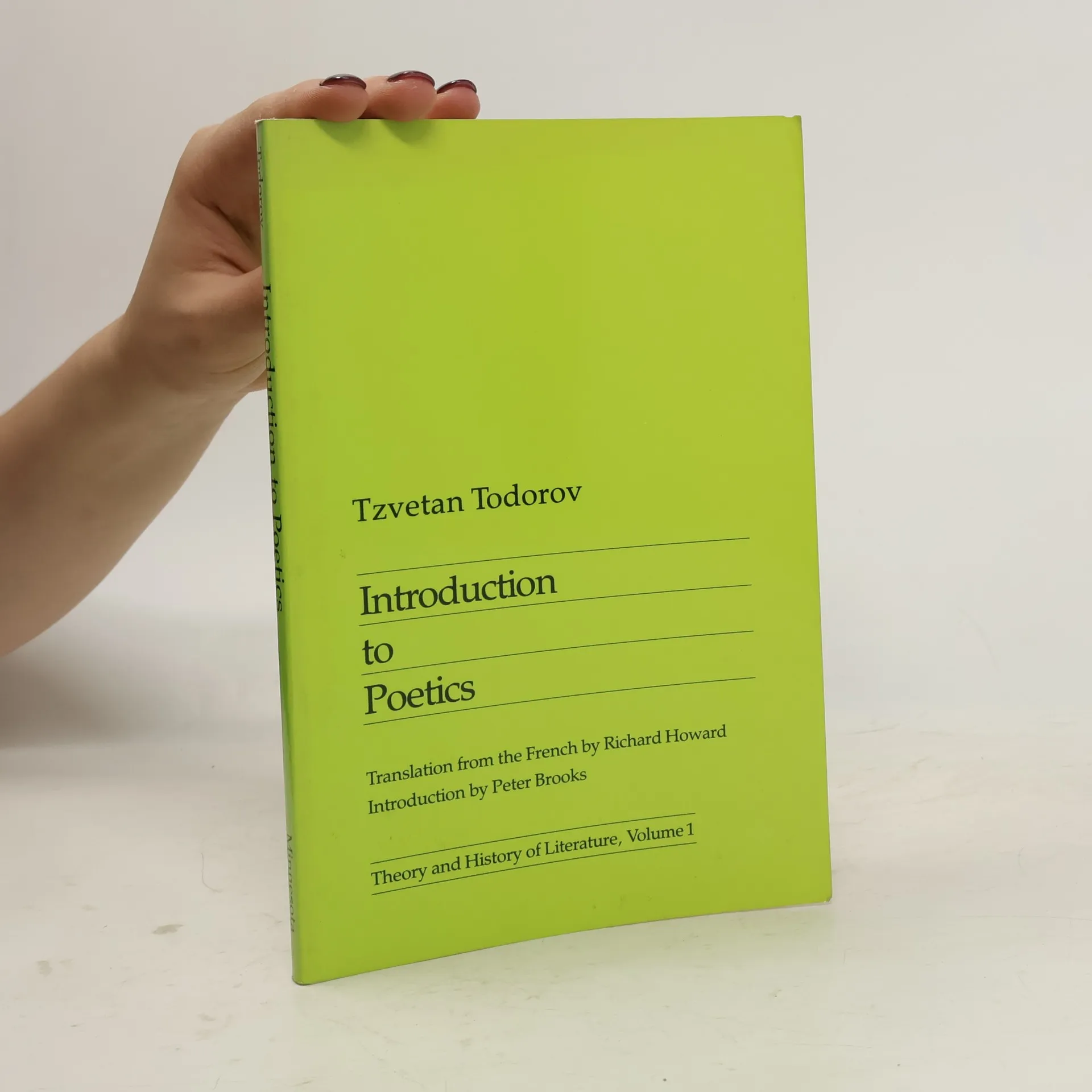
Introduction to Poetics, Tzvetan Todorov
- Langue

- Année de publication
- 1981
- Reliure
- (souple)
Modes de paiement
Il manque plus que ton avis ici.
- Titre
- Introduction to Poetics
- Sous-titre
- Theory and History of Literature, Volume 1
- Langue
- Anglais
- Auteurs
- Tzvetan Todorov
- Publié
- 1981
- Format
- souple
- Pages
- 83
- ISBN10
- 0816610088
- ISBN13
- 9780816610082
- Séries
- Mots clés
- Histoire littéraire, Poétique
- Évaluation
- 3 sur 5
- Description
- Tzvetan Todorov represents a convergence point for various trends in the social sciences and literary criticism. The methods of Russian Formalists like Shklovsky and Tinyanov, Roman Jakobson and the Prague Linguistic Circle, as well as structuralist and post-structuralist critics like Roland Barthes and Gerard Genette, reach a synthesis in Todorov's work. Poetics investigates the conditions and elements that make individual works "literary," rather than focusing solely on the works themselves. The aim of Todorov and structuralist literary studies is to critique and transcend an "atomistic" reading style. Each text, whether spoken or written, exists within a multi-dimensional web of meaning alongside other texts, differentiating itself along various axes. The attainment of "literariness," which is the main subject of poetics, depends on the reader's ability to mentally visualize this matrix, or in other words, to engage with these differentiations within their own reading. Todorov's Introduction to Poetics presents a preliminary account of these processes that every good reader performs, both consciously and unconsciously.