

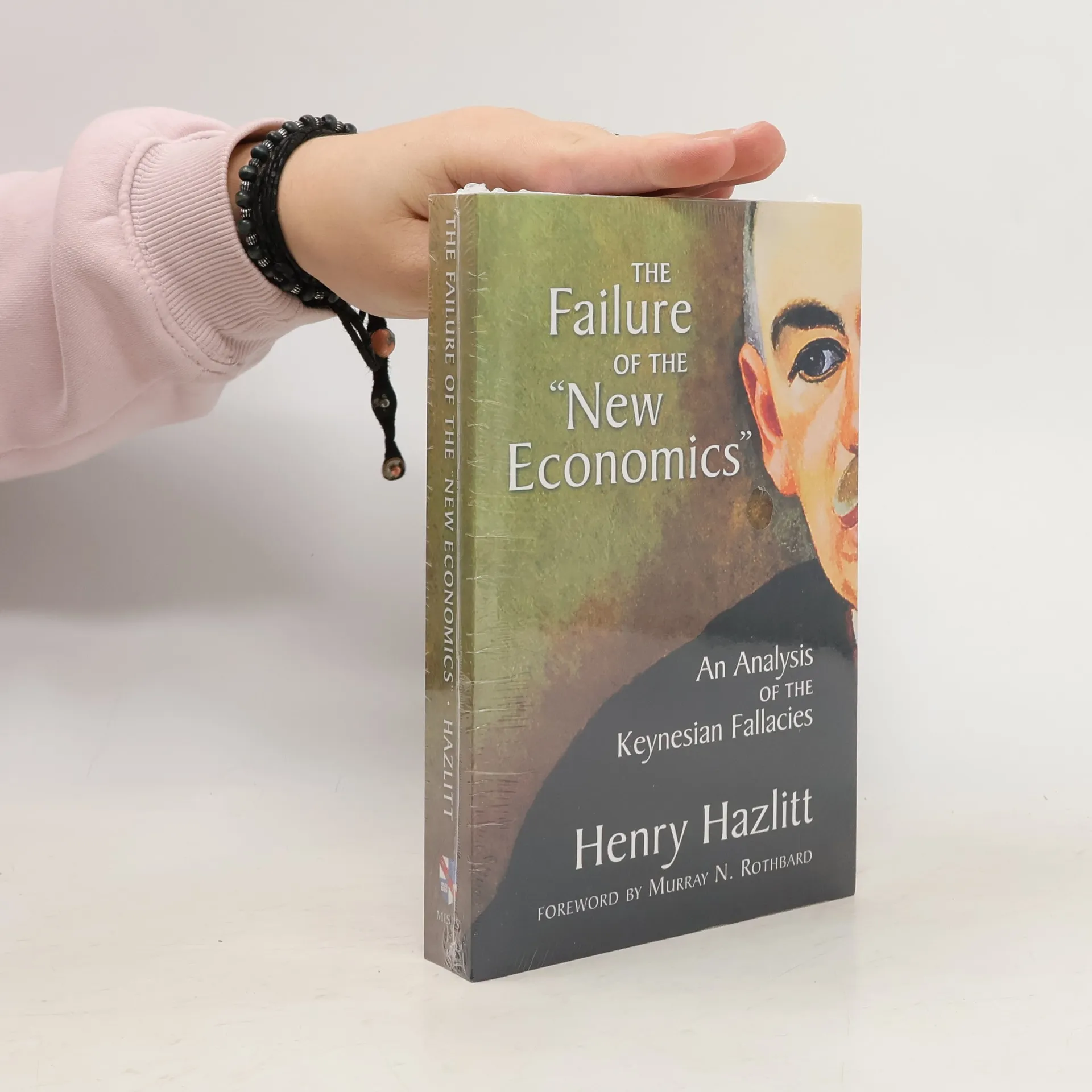

En savoir plus sur le livre
Henry Hazlitt did the seemingly impossible, something that was and is a magnificent service to all people everywhere. He wrote a line-by-line commentary and refutation of one of the most destructive, fallacious, and convoluted books of the century. The target here is John Maynard Keynes's General Theory, the book that appeared in 1936 and swept all before it. In economic science, Keynes changed everything. He supposedly demonstrated that prices don't work, that private investment is unstable, that sound money is intolerable, and that government was needed to shore up the system and save it. It was simply astonishing how economists the world over put up with this, but it happened. He converted a whole generation in the late period of the Great Depression. By the 1950s, almost everyone was Keynesian. But Hazlitt, the nation's economics teacher, would have none of it. And he did the hard work of actually going through the book to evaluate its logic according to Austrian-


Achat du livre
The Failure of the New Economics, Henry Hazlitt, Murray Newton Rothbard
- Langue

- Année de publication
- 2007
- Reliure
- (souple)
Modes de paiement
Il manque plus que ton avis ici.
- Titre
- The Failure of the New Economics
- Sous-titre
- An Analysis of the Keynesian Fallacies
- Langue
- Anglais
- Auteurs
- Henry Hazlitt, Murray Newton Rothbard
- Éditeur
- Ludwig von Mises Institute
- Publié
- 2007
- Format
- souple
- Pages
- 451
- ISBN10
- 1933550112
- ISBN13
- 9781933550114
- Séries
- Catégories
- Mots clés
- Thème historique, Commerce, Thématique philosophique, Politique
- Évaluation
- 4,15 sur 5
- Description
- Henry Hazlitt did the seemingly impossible, something that was and is a magnificent service to all people everywhere. He wrote a line-by-line commentary and refutation of one of the most destructive, fallacious, and convoluted books of the century. The target here is John Maynard Keynes's General Theory, the book that appeared in 1936 and swept all before it. In economic science, Keynes changed everything. He supposedly demonstrated that prices don't work, that private investment is unstable, that sound money is intolerable, and that government was needed to shore up the system and save it. It was simply astonishing how economists the world over put up with this, but it happened. He converted a whole generation in the late period of the Great Depression. By the 1950s, almost everyone was Keynesian. But Hazlitt, the nation's economics teacher, would have none of it. And he did the hard work of actually going through the book to evaluate its logic according to Austrian-