





Séries
Paramètres
- 116pages
- 5 heures de lecture
En savoir plus sur le livre
The Four Quartets is a series of four poems by T.S. Eliot, published individually from 1936 to 1942, and in book form in 1943; it was considered by Eliot himself to be his finest work. Each of the quartets has five "movements" and each is titled by a place name -- BURNT NORTON (1936), EAST COKER (1940), THE DRY SALVAGES (1941), and LITTLE GIDDING (1942). Eliot's insights into the cyclical nature of life are revealed through themes and images woven throughout the four poems. Spiritual, philosophical, and personal themes emerge through symbolic allusions and literary and religious references from both Eastern and Western thought. The work addresses the connections of the personal and historical present and past, spiritual renewal, and the very nature of experience; it is considered the poet's clearest exposition of his Christian beliefs. (The Merriam-Webster Encyclopedia of Literature)

Achat du livre
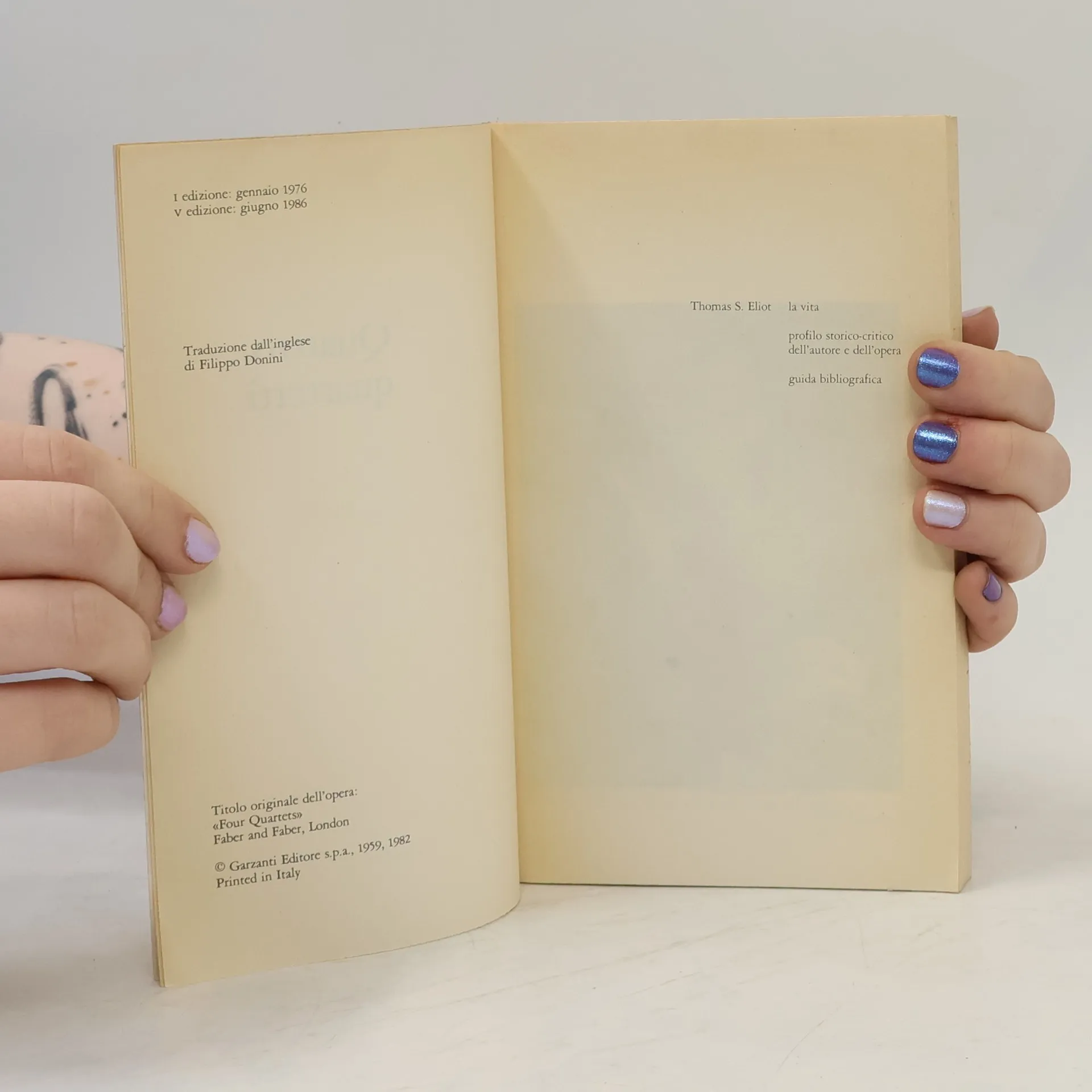
Quattro quartetti, T. S. Eliot
- Langue


- Année de publication
- 1989
- product-detail.submit-box.info.binding
- (souple),
- État du livre
- Abîmé
- Prix
- 1,61 €
Modes de paiement
Il manque plus que ton avis ici.
- Titre
- Quattro quartetti
- Langue
- Anglais, Italien
- Auteurs
- T. S. Eliot
- Éditeur
- Garzanti Editore
- Publié
- 1989
- Format
- souple
- Pages
- 116
- ISBN10
- 8811581435
- ISBN13
- 9788811581437
- Séries
- Quatre Quatuors
- Mots clés
- Fiction, Thème historique, Poésie, Thématique philosophique, Classiques, 20e siècle, Littérature américaine, Littérature anglaise, Édition bilingue, Édition bilingue, Modernisme
- Première publication
- 1943
- Titre original
- Four Quartets
- Évaluation
- 4,35 sur 5
- Description
- The Four Quartets is a series of four poems by T.S. Eliot, published individually from 1936 to 1942, and in book form in 1943; it was considered by Eliot himself to be his finest work. Each of the quartets has five "movements" and each is titled by a place name -- BURNT NORTON (1936), EAST COKER (1940), THE DRY SALVAGES (1941), and LITTLE GIDDING (1942). Eliot's insights into the cyclical nature of life are revealed through themes and images woven throughout the four poems. Spiritual, philosophical, and personal themes emerge through symbolic allusions and literary and religious references from both Eastern and Western thought. The work addresses the connections of the personal and historical present and past, spiritual renewal, and the very nature of experience; it is considered the poet's clearest exposition of his Christian beliefs. (The Merriam-Webster Encyclopedia of Literature)