The Fable of the Bees begins with a poem and continues with a number of essays and dialogues. It is all tied together by the startling and original idea that “private vices” (self-interest) lead to “publick benefits” (the development and operation of society). From that simple beginning, Mandeville saw that orderly social structures (such as law, language, the market, and even the growth of knowledge) were a spontaneous growth developing out of individual human actions
Bernard de Mandeville Livres
15 novembre 1670 – 21 janvier 1733
Bernard Mandeville fut un philosophe, économiste politique et satiriste. Il s'est fait connaître comme un observateur et critique perspicace de la nature humaine et des conventions sociales. Par l'ironie et l'allégorie, il a exposé l'hypocrisie et l'intérêt personnel qui se cachent sous le vernis de la vertu apparente. Son œuvre invite à la contemplation de la relation complexe entre les désirs individuels et le bien collectif.





An Enquiry into An Origin of Honour; And the Usefulness of Christianity in War
in large print
- 216pages
- 8 heures de lecture
The publishing house Megali focuses on making historical works more accessible by producing them in large print, catering specifically to individuals with impaired vision. This initiative aims to enhance the reading experience for those who may struggle with standard text sizes, ensuring that important historical texts remain available to a wider audience.
F. B. Kaye Edition - 1: The Fable of the Bees
Or Private Vices, Publick Benefits
- 558pages
- 20 heures de lecture
Mandeville is the wittiest and shrewdest philosopher ever to make a significant impact upon economics. He anticipated Oscar Wilde in choosing his enemies with great care, and within his own century they included David Hume, Adam Smith, and Francis Hutcheson. He could afford even such enemies because his friends and admirers have been legion. — George J. Stigler, University of Chicago It used to be that everyone read the "notorious" Bernard Mandeville (1670–1733). He was a great satirist and came to have a profound impact on economics, ethics, and social philosophy. The Fable begins with a poem and continues with a number of essays and dialogues. It is all tied together by the startling and original idea that "private vices" (self-interest) lead to "publick benefits" (the development and operation of society). From that simple beginning, Mandeville saw that orderly social structures (such as law, language, the market, and even the growth of knowledge) were a spontaneous growth developing out of individual human actions.
F. B. Kaye Edition - 2: The Fable of the Bees
Or Private Vices, Publick Benefits
- 481pages
- 17 heures de lecture
Mandeville is the wittiest and shrewdest philosopher ever to make a significant impact upon economics. He anticipated Oscar Wilde in choosing his enemies with great care, and within his own century they included David Hume, Adam Smith, and Francis Hutcheson. He could afford even such enemies because his friends and admirers have been legion. — George J. Stigler, University of Chicago It used to be that everyone read the "notorious" Bernard Mandeville (1670–1733). He was a great satirist and came to have a profound impact on economics, ethics, and social philosophy. The Fable begins with a poem and continues with a number of essays and dialogues. It is all tied together by the startling and original idea that "private vices" (self-interest) lead to "publick benefits" (the development and operation of society). From that simple beginning, Mandeville saw that orderly social structures (such as law, language, the market, and even the growth of knowledge) were a spontaneous growth developing out of individual human actions.
Mit 'A Modest Defence of Publick Stews' wurde der englischen Leserschaft 1724 von einem gewissen Phil-Porney, einem „Liebhaber der Huren“, ein wahrhaft delikater Eintopf kredenzt. Bereits im Titel dieser klandestinen Schrift – die rasch zu einem europaweiten Bestseller wurde – spielt der Autor hintersinnig auf öffentliche Freudenhäuser an: Mit 'stews', eigentlich schmorende Eintöpfe, sind Bordelle gemeint, quasi heiße Orte, an denen die Säfte zum Brodeln kommen. Der Autor, der schon in seiner ebenfalls anonym erschienenen 'Bienenfabel' die provokante These aufstellte, private Laster trügen zum öffentlichen Wohl bei, präsentiert mit seinem 'Versuch über die Hurerei' eine herrlich unterhaltsame Satire auf die Vertreter einer sittenstrengen Doppelmoral. Ursula Pia Jauch ist mit ihrer deutschen Erstübersetzung von Bernard Mandevilles brisantem Buch eine wahre Entdeckung gelungen; wie nebenbei macht sie überdies in ihrem klugen Essay eine ganze Epoche lebendig.
Původně dvacetistránková báseň (1705) byla rozšířena o dvacet Poznámek, z nichž mnohé dosahují desítek stránek, (1714) a konečně doplněna dvěma eseji (1723).
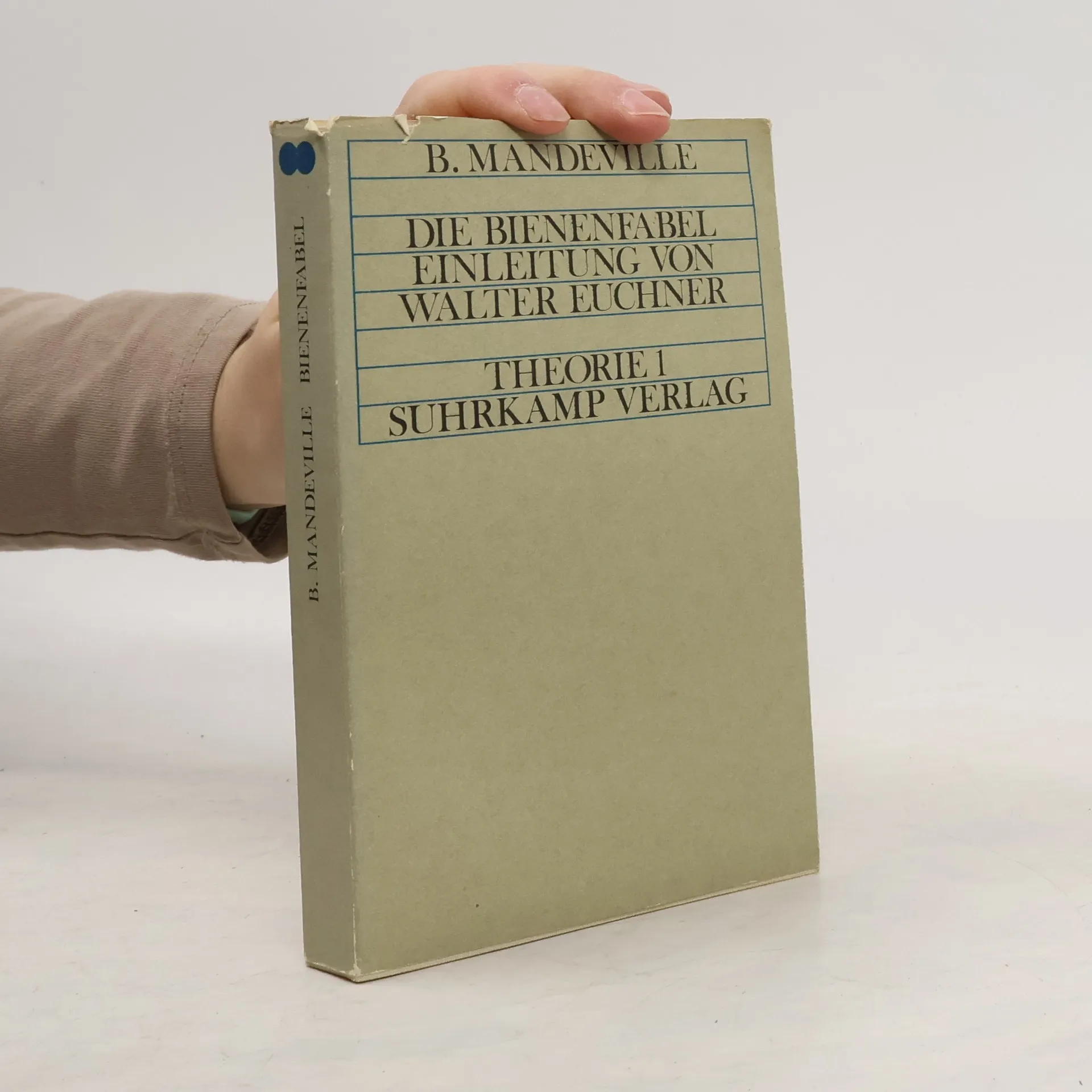
Bernard Mandeville: Die Bienenfabel
oder Der Einzelnen Laster, des Ganzen Gewinn
- 346pages
- 13 heures de lecture