Pidgins and creoles. Volume II, Reference survey
- 476pages
- 17 heures de lecture
An overview of the socio-historical development of some one hundred different pidgins and creoles.



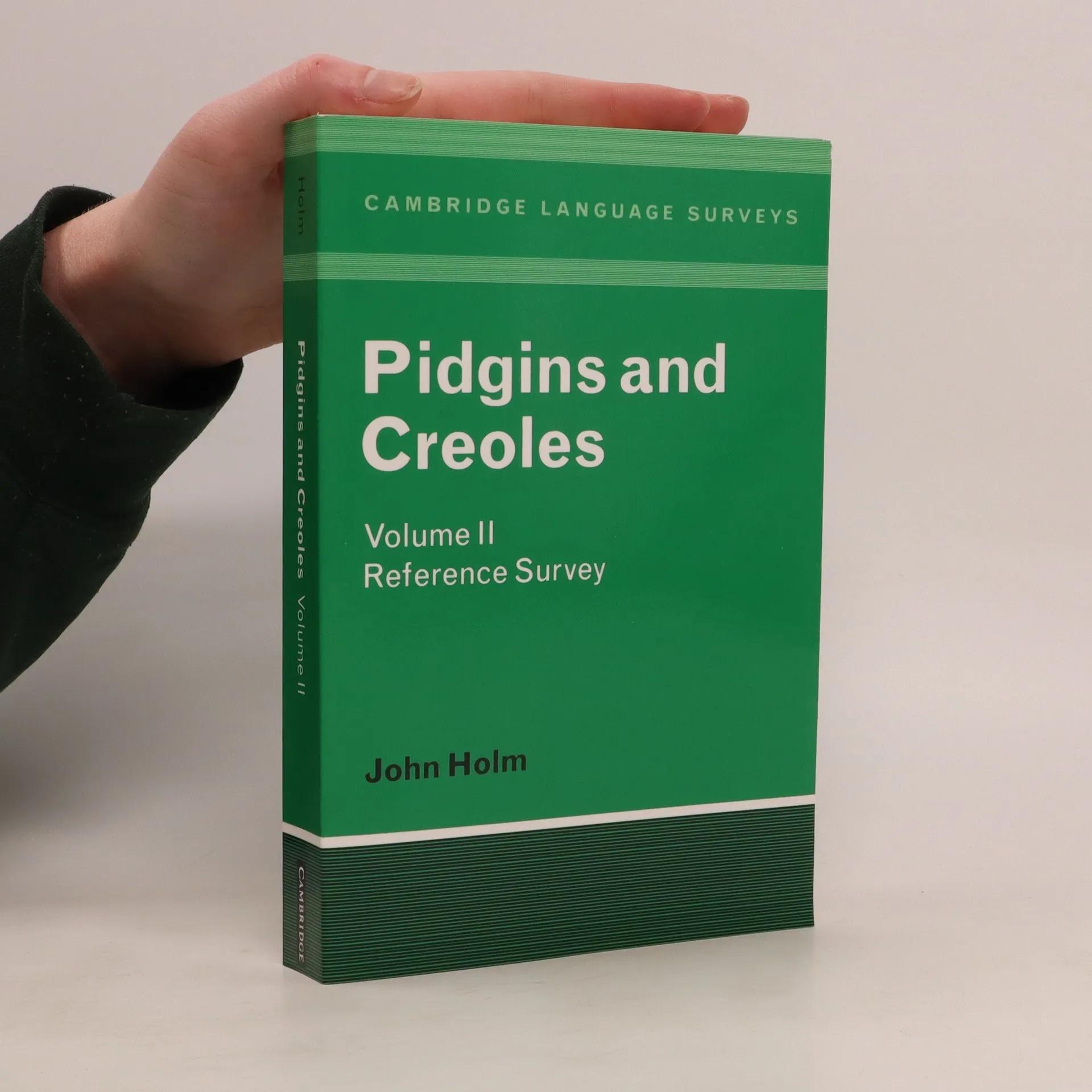

An overview of the socio-historical development of some one hundred different pidgins and creoles.
This first volume of Holm's extensive survey of pidgins and creoles offers a contemporary and accessible introduction to a field that has emerged in recent decades. Aimed at both students and general readers with a foundational understanding of linguistics, the book's unique perspective will also engage specialists seeking a comprehensive overview of linguistic relationships among these languages. Creolized versions of English, French, Spanish, Dutch, Portuguese, and others developed during European colonial expansion, leading to creoles like Jamaican, Haitian, Papiamentu, and approximately one hundred others, as well as semi-creoles such as Afrikaans and American Black English. Traditionally, scholars have focused on specific language varieties in isolation, complicating comparative research on the origins, evolution, and structure of creoles. Holm's work draws on extensive studies of multiple languages to highlight the significant similarities among creoles and to challenge existing linguistic theories. The volume emphasizes empirical analysis over mere description, featuring a comparative study of creoles derived from European languages in Africa and the Caribbean, showcasing notable similarities in lexical semantics, phonology, and syntax. A subsequent volume will provide a socio-historic overview of language development and include text examples with translations of the restructured languages.
Dieser Band behandelt die anglophonen Kreolsprachen an der Karibikküste von Mittelamerika (Belize, Honduras, Nicaragua, Costa Rica, Panama) und seinen vorgelagerten Inseln (Providencia, San Andrés und den Caymaninseln). Die Untersuchung dieser anglophonen Varietäten ist vergleichsweise neu und basiert auf aktuellen Feldforschungen von Belize bis Panama. Eine der interessanten Eigenschaften, die sich herauskristallisiert, ist die vorläufige Karte der diachronen und synchronen Beziehungen unter den anglophonen Kreolsprachen der Karibik, die teilweise durch das Lexikon und teilweise durch grammatische Konstruktionen veranschaulicht wird. Die Studien in diesem Buch basieren auf phonetischen Transkriptionen von Sprachakten in ihrem sozialen und linguistischen Kontext.