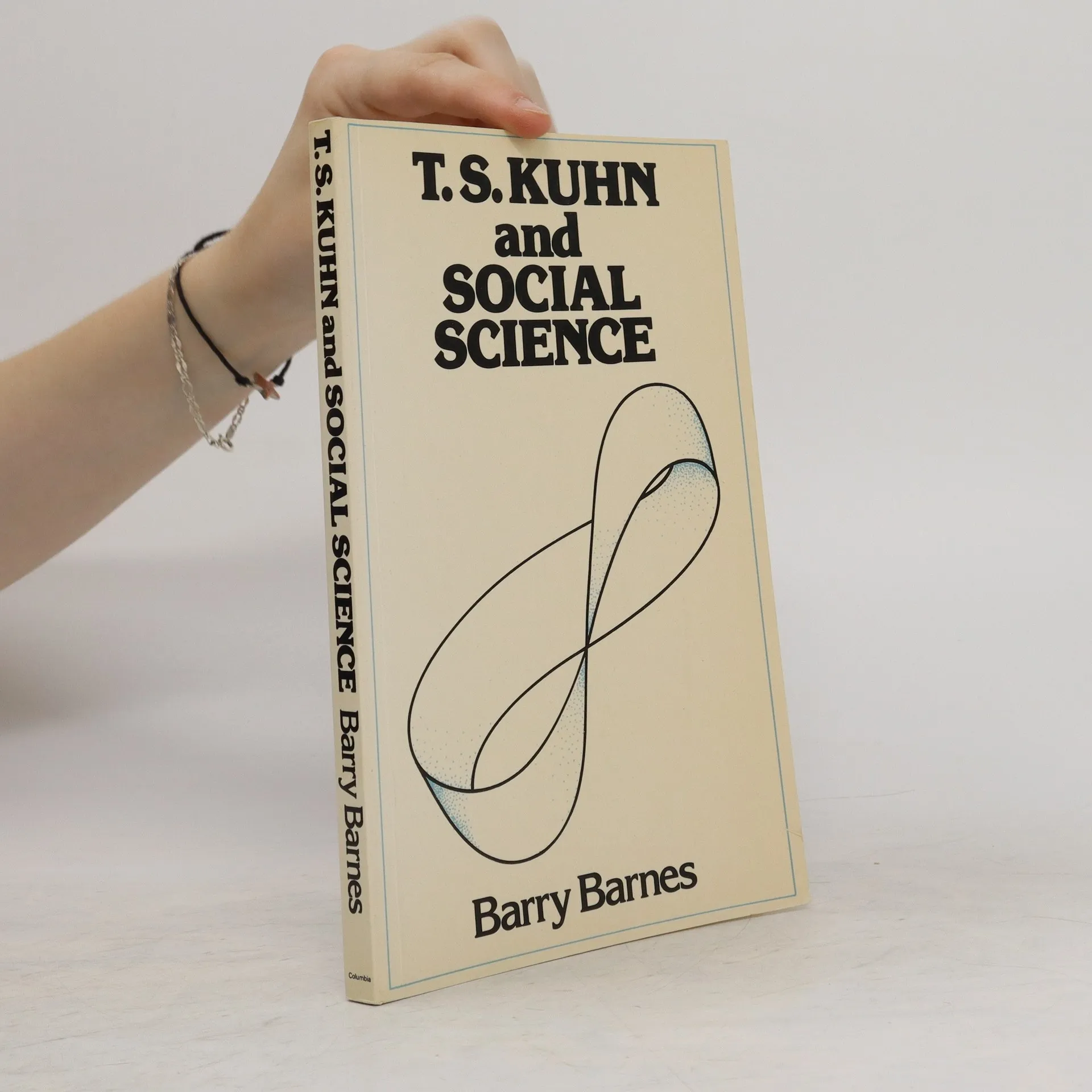
S. Barry Barnes était Professeur de Sociologie à l'Université d'Exeter. Il est reconnu pour ses travaux pionniers sur l'étude sociologique de la génération et de l'évaluation des connaissances scientifiques, ainsi que sur la crédibilité de l'expertise scientifique. Ses recherches éclairent la manière dont les savoirs scientifiques sont créés et comment la société évalue leur validité.
The authors bring the perspectives of sociology and anthropology to bear on key historical developments in various fields of science, demonstrating that it is possible to study science in the same way as other forms of culture - art, music, and literature. They show that our understanding of science, and the development of scientific knowledge, can be enriched by these perspectives, and that the history of science can benefit from case studies, such as those presented here.
This collection of eighteen readings serves as a foundational text for undergraduates in sociology of science courses. It surveys articles published between 1961 and 1981, offering a valuable overview for students in social and political studies of science, science and technology, and related fields such as environmental sciences, geography, philosophy, and history of science. The editors focus on the relationship between the subculture of science and the surrounding wider culture. From this perspective, science emerges as a source of knowledge and competence, emphasizing its interaction with context. This approach not only highlights aspects of science that are of practical interest but also raises crucial issues regarding credibility, authority distribution in society, and cultural interactions. The essays are organized into five sections: The Organization of Academic Communication and Control; The Culture of Science; The Interaction of Science and Technology; The Interaction of Science and Society; and Science as Expertise. The editors provide a general introduction, section introductions, bibliographical notes, and an extensive bibliography. Barry Barnes is a Lecturer at the Science Studies Unit, University of Edinburgh, while David Edge serves as the Director of the same unit and is a joint editor of the journal, Social Studies of Science.
Over the past quarter century, social theory has diverged in various directions, highlighting differences in approach. In this original work, Barry Barnes uses this intellectual diversity to unify central perspectives in the field. He addresses a key issue for students of society: the conflict between cultural and functional methods of describing social order and choice-theoretic accounts. Instead of detailing the origins of these views, Barnes engages in a dialogue between them, uncovering their strengths and weaknesses. He advocates for a theoretical "third way," proposing an interactionist understanding of social dynamics and the emergence of behavioral norms. By applying interactionist analysis, typically reserved for micro-social contexts, to macro-phenomena such as status group formation, social movements, class politics, and bureaucratic dynamics, he demonstrates that these issues cannot be fully explained by cultural-functional or choice-theoretic methods alone. Understanding these phenomena requires examining how norms develop through interaction. Barnes presents a coherent vision of social theory fundamentals that will engage sociologists and social scientists alike. Originally published in 1995, this work is now available in a durable paperback edition through the Princeton Legacy Library, which aims to enhance access to important scholarly texts.
This is a book about science. Nobody will learn any science by reading it but they will discover something about science and its place in modern society. The study of natural sciences at school level is largely confined to acquiring basic facts and research techniques. This book will help students pursuing their interest in science to make the leap to the more critical, questioning, imaginative approach that is demanded at higher levels. With a combination of criticism and inspiration, wit and example, Batty Barnes conveys fresh and stimulating insights into scientific thought and knowledge. He introduces the reader to new models, images and methods which will enable them to appreciate the complex interplay between invention and ideology, authority and institutions, that shapes modern science.
The Grateful Dead, one of the most popular bands of all time, still enjoys incredible relevance to this day. But let's admit it, they weren't exactly poster boys for corporate America. Or were they? For an extraordinary 30 years, the Dead improvised a business plan-all while making huge profits and pioneering practices subsequently embraced by the business world. Now, business professor and lifelong Deadhead Barry Barnes shares the 10 most innovative business lessons from the band's illustrious career, including: creating and delivering superior customer value; implementing a flat management structure; sharing your content; and more. Barnes shows how the Dead were masters of "strategic improvisation"-the ability to adapt to changing times and circumstances-and that their success lay in their commitment to relentless variation. EVERYTHING I KNOW ABOUT BUSINESS I LEARNED FROM THE GRATEFUL DEAD teaches readers how they did it-and what any business can learn from their long, strange trip.
Intriguingly different in approach from conventional works in the same area of inquiry, this study deals with the central problems and concerns of the sociology of knowledge as it has traditionally been conceived of. It is concerned with the relationship of knowledge, social interests, and social structure, and with the various attempts which have been made to analyze the relationship.
Barry Barnes takes the classic writings in the sociology of knowledge - by Marx, Lukacs, Weber, Mannheim, Goldmann, Habermas, and others - and uses them as resources in coming to grips with what he regards as the currently most interesting and significant questions in this area. This approach reflects one of the principal themes of the book itself. Knowledge is best treated as a resource available to those possessing it. This is the best perspective from which to understand its relationship to action and its historical significance; it is a perspective which avoids the problems of holding that knowledge is derivative, as well as those generated by the view that knowledge is a strong determinant of consciousness. The result is an unusual textbook, particularly valuable when read in conjunction with the original works it discusses.
Although science was once seen as the product of individual great men working in isolation, we now realize that, like any other creative activity, science is a highly social enterprise, influenced in subtle as well as obvious ways by the wider culture and values of its time. Scientific Knowledge is the first introduction to social studies of scientific knowledge.The authors, all noted for their contributions to science studies, have organized this book so that each chapter examines a key step in the process of doing science. Using case studies from cognitive science, physics, and biology to illustrate their descriptions and applications of the social study of science, they show how this approach provides a crucial perspective on how science is actually done.Scientific Knowledge will be of interest not only to those engaged in science studies, but also to anyone interested in the practice of science.