Liberty in the Things of God
- 248pages
- 9 heures de lecture
From one of the leading historians of Christianity comes this sweeping reassessment of religious freedom, from Tertullian to John Locke




From one of the leading historians of Christianity comes this sweeping reassessment of religious freedom, from Tertullian to John Locke
The book presents a provocative argument that challenges the existence of a singular Christian faith or universal interpretation of Christ's meaning throughout history. It offers a compelling narrative supported by extensive evidence, encouraging readers to reconsider established beliefs and explore the complexities of religious understanding. The vivid writing style enhances the exploration of these themes in a concise format.
Focusing on major figures such as St. Augustine and Gregory of Nyssa, as well as a host of less well known thinkers, Robert Wilken (the author of The First Thousand Years: A Global History of Christianity) chronicles the emergence of a specifically Christian intellectual tradition. He provides an introduction to early Christian thought on topics including early Christian worship, Christian poetry and the spiritual life, the Trinity, Christ, the Bible, and icons, and shows that the energy and vitality of early Christianity arose from within the life of the Church. While early Christian thinkers drew on the philosophical and rhetorical traditions of the ancient world, it was the versatile vocabulary of the Bible that loosened their tongues and minds and allowed them to construct the world anew, intellectually and spiritually. These thinkers were not seeking to invent a world of ideas, Wilken shows, but rather to win the hearts of men and women and to change their lives. Early Christian thinkers set in place a foundation that has endured. Their writings are an irreplaceable inheritance, and Wilken shows that they can still be heard as living voices within contemporary culture.
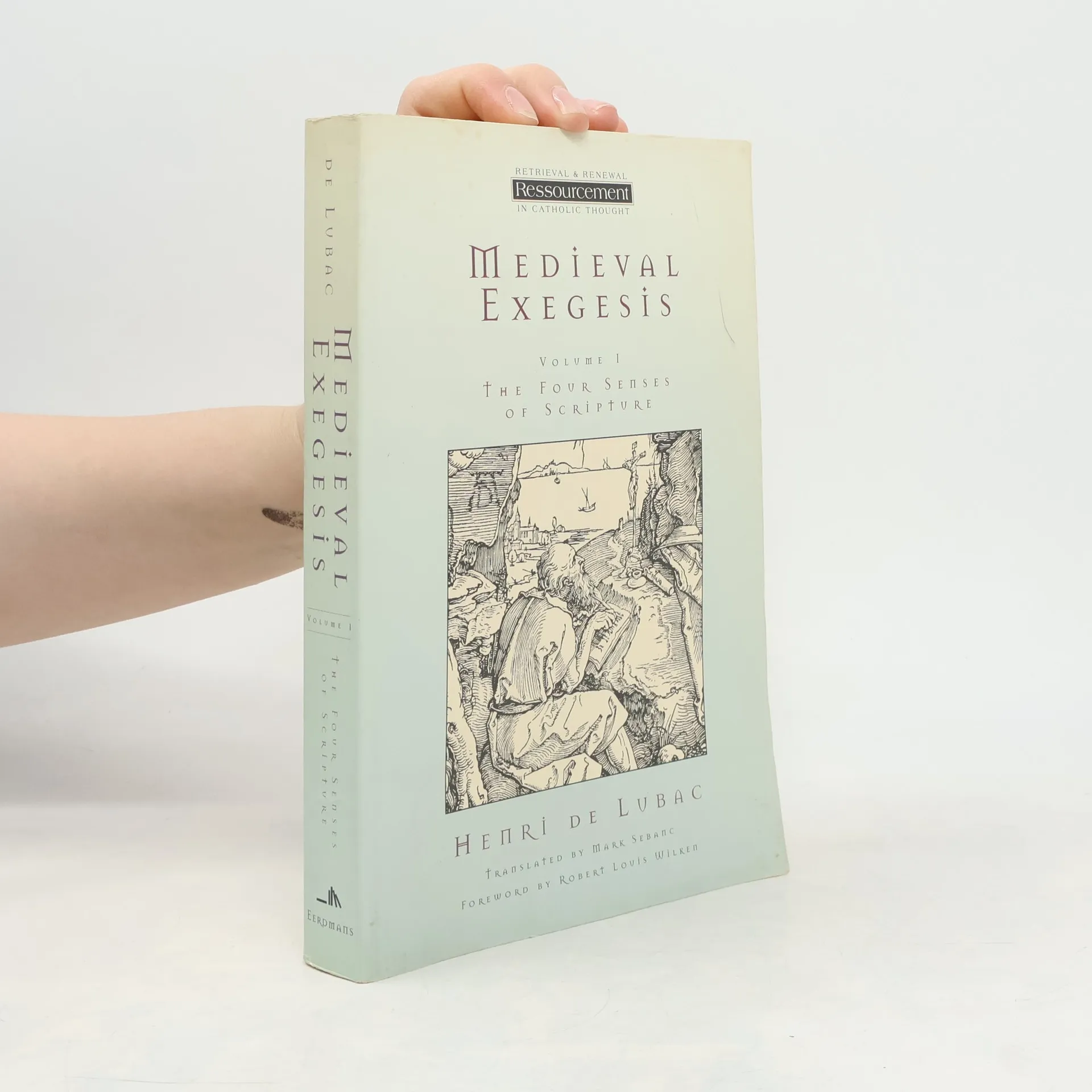
The Four Senses of Scripture
Originally published in French as Exégèse médiévale , Henri de Lubac's multivolume study of medieval exegesis and theology has remained one of the most significant works of modern biblical studies. Available now for the first time in English, this long-sought-after volume is an essential addition to the library of those whose study leads them into the difficult field of biblical interpretation. The first volume in de Lubac's multivolume work begins his comprehensive historical and literary study of the way Scripture was interpreted by the church of the Latin Middle Ages. Examining the prominent commentators of the Middle Ages and their texts, de Lubac discusses the medieval approach to biblical interpretation that sought "the four senses" of Scripture, especially the dominant practice of attempting to uncover Scripture's allegorical meaning. Though Bible interpreters from the Enlightenment era on have criticized such allegorizing as part of the "naivete of the Middle Ages," de Lubac insists that a full understanding of this ancient Christian exegesis provides important insights for us today.