

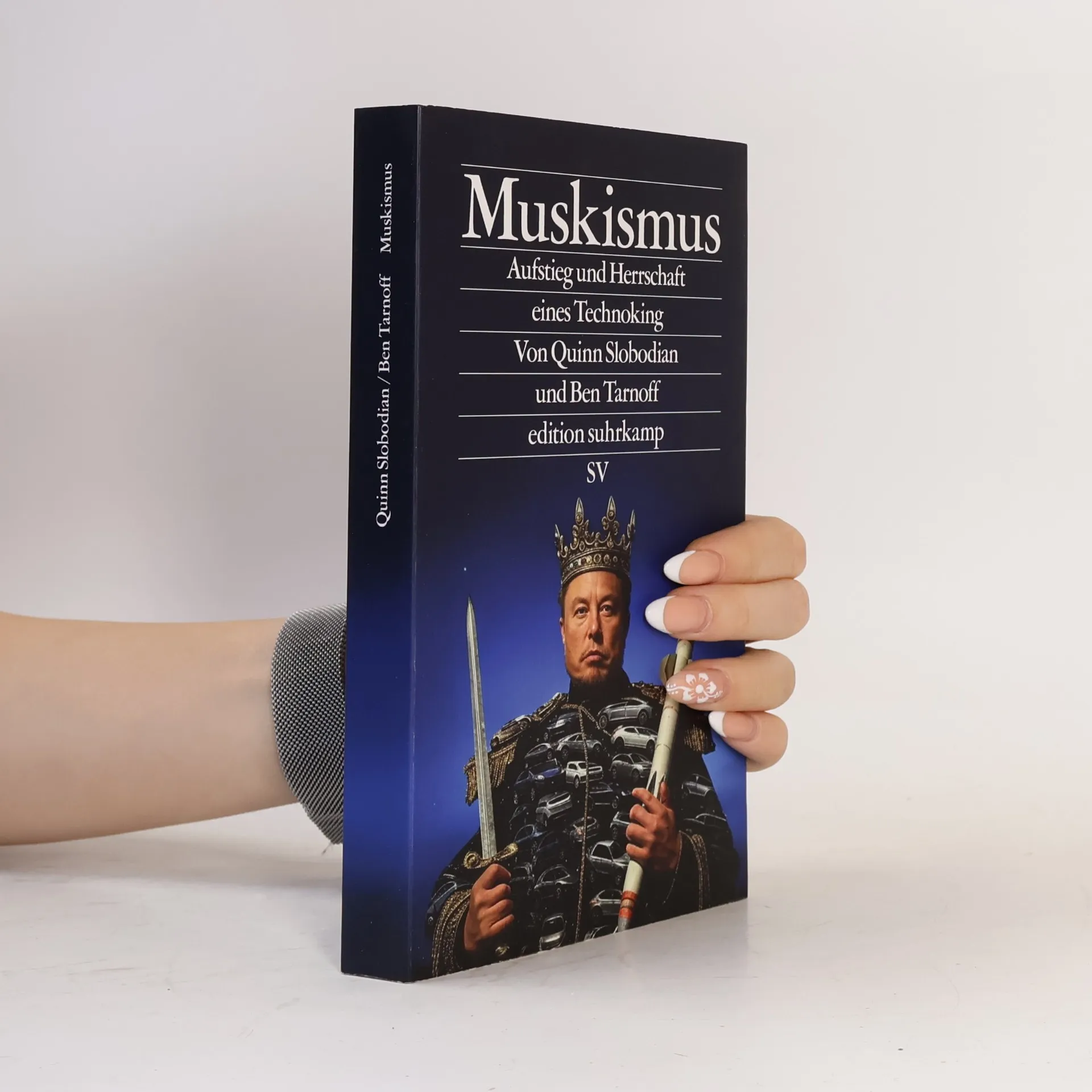
Mit Paypal hat Elon Musk die Finanzbranche aufgemischt, mit Tesla den Markt für E-Autos revolutioniert, nach seiner Übernahme Twitter kurzerhand auf rechts gedreht. Im US-Wahlkampf hat er sich zu einem der wichtigsten Einflüsterer Donald Trumps aufgeschwungen, nun ist er mit seiner Abteilung für Regierungseffizienz dabei, den amerikanischen Staat zu zerlegen. Wie wurde aus dem genialischen Nerd eine kettensägenschwingende Ikone der globalen Rechten? Um die Welt zu begreifen, die Musk erschafft, müssen wir die Welten verstehen, die Musk erschaffen haben. Quinn Slobodian und Ben Tarnoff zeichnen nach, wie sich im Silicon Valley um die Vorstellungen von Disruption und tollkühnen CEOs ein regelrechter Kult bildete, wie soziale Medien und Videospiele die Erzählung vom heldenhaften Einzelgänger etablierten und wie rassistische Memes und Verschwörungstheorien Eingang fanden in die Gedankenwelt des reichsten Menschen der Erde. Der Muskismus, so Slobodian und Tarnoff, ist ein frankensteinsches Monster des zeitgenössischen Kapitalismus.
Quinn Slobodian Ordre des livres (chronologique)

How neoliberals turned to nature to defend inequality after the end of the Cold War. Neoliberals should have seen the end of the Cold War as a total victory—but they didn’t. Instead, they saw the chameleon of communism changing colors from red to green. The poison of civil rights, feminism, and environmentalism ran through the veins of the body politic and they needed an antidote. To defy demands for equality, many neoliberals turned to nature. Race, intelligence, territory, and precious metal would be bulwarks against progressive politics. Reading and misreading the writings of their sages, Friedrich Hayek and Ludwig von Mises, they articulated a philosophy of three hards—hardwired human nature, hard borders, and hard money—and forged alliances with racial psychologists, neoconfederates, ethnonationalists, and goldbugs that would become known as the alt-right. Following Hayek’s bastards from Murray Rothbard to Charles Murray to Javier Milei, we find that key strains of the Far Right emerged within the neoliberal intellectual movement not against it. This history of ideas shows us that the reported clash of opposites is more like a family feud.
Crack-Up Capitalism
- 352pages
- 13 heures de lecture
'Gonzo brilliance ... unique and highly entertaining' Financial Times 'Revelatory reading' Adam Tooze, author of Crashed 'After reading Quinn Slobodian's new book, you are not likely to think about capitalism the same way' Jacobin Look at a map of the world and you'll see a neat patchwork of nation-states. But this is not where power actually resides. From the 1990s onwards, globalization has shattered the map, leading to an explosion of new legal entities: tax havens, free ports, city-states, gated enclaves and special economic zones. These new spaces are freed from ordinary forms of regulation, taxation and mutual obligation - and with them, ultracapitalists believe that it is possible to escape the bonds of democratic government and oversight altogether. Historian Quinn Slobodian follows the most notorious radical libertarians - from Milton Friedman to Peter Thiel - around the globe as they search for the perfect home for their free market fantasy. The hunt leads from Hong Kong in the 1970s to South Africa in the late days of apartheid, from the neo-Confederate South to the medieval City of London, and finally into the world's oceans and war zones, charting the relentless quest for a blank slate where capitalism and democracy can be finally uncoupled. Crack-Up Capitalism is a propulsive history of the recent past, and an alarming view of our near future.
This study offers a comprehensive examination of neoliberalism's advocates in Eastern Europe and the Global South, addressing the origins of free market ideology. While recent scholarship on the Mont Pelerin Society has enhanced our understanding of the interplay between ideas, interests, and institutions, it often reflects a Eurocentric perspective. The narrative typically portrays neoliberalism as a diffusion of ideas from the Global North to the periphery, with notable exceptions like Chile under Augusto Pinochet. However, the existing literature predominantly features a limited cast of influential figures, such as Milton Friedman and Friedrich Hayek. This work seeks to rectify that by highlighting a diverse array of voices from the Global South and Eastern Europe involved in the transnational neoliberal movement. It includes figures like B.R. Shenoy from India, recognized for his role in the Mont Pelerin Society, and Manuel Ayau, founder of Marroquin University in Latin America. Additionally, it explores how Chinese intellectuals adapted Hayek and Mises to their contexts. By examining neoliberalism from outside the industrial core, the study reveals the appeal of radical capitalism to various populations and how their innovative policy ideas were localized.
Globalists: The End of Empire and the Birth of Neoliberalism
- 400pages
- 14 heures de lecture
Neoliberals are often perceived as opponents of the state, yet their history reveals a more complex relationship. In this intellectual exploration, Quinn Slobodian traces the evolution of neoliberal globalism from the aftermath of the Habsburg Empire to the establishment of the World Trade Organization. He argues that neoliberalism did not aim to diminish government or eliminate regulations but sought to reposition them on a global scale. Beginning in 1920s Austria, amidst the disintegration of empires and the rise of nationalism and socialism, Austrian thinkers advocated for a new global order. Key figures, including Friedrich Hayek and Ludwig von Mises, along with lesser-known economists like Wilhelm Roepke and Michael Heilperin, rejected a laissez-faire approach. Instead, they leveraged states and international institutions—such as the League of Nations, the European Court of Justice, and international investment law—to shield markets from sovereign states and the demands for equality and social justice. Slobodian highlights that neoliberals aimed to utilize regulatory frameworks to safeguard capitalism globally. This ambitious project reshaped the world but was repeatedly challenged by the inequalities and social injustices it generated.