A provocative reassessment of Heidegger’s critique of German Idealism from one of the tradition’s foremost interpreters. Heidegger claimed that Western philosophy ended—failed, even—in the German Idealist tradition. In The Culmination, Robert B. Pippin explores the ramifications of this charge through a masterful survey of Western philosophy, especially Heidegger’s critiques of Hegel and Kant. Pippin argues that Heidegger’s basic concern was to determine sources of meaning for human life, particularly those that had been obscured by Western philosophy’s attention to reason. The Culmination offers a new interpretation of Heidegger, German Idealism, and the fate of Western rationalism.
Robert B. Pippin Ordre des livres (chronologique)
14 septembre 1948
Robert B. Pippin est un penseur éminent qui explore l'idéalisme allemand et la philosophie moderne. Son œuvre plonge dans des questions profondes de conscience de soi, de liberté et de la nature du changement conceptuel. Pippin enquête sur la manière dont les idées philosophiques imprègnent l'art et la littérature, éclairant les liens complexes entre la moralité et le cinéma. Ses analyses incisives offrent aux lecteurs de nouvelles perspectives sur les questions durables de la condition humaine.

It would be easy to dismiss the films of Douglas Sirk (1897-1987) as brilliant examples of mid-century melodrama with little to say to the contemporary world. Yet Robert Pippin argues that, far from being marginal pieces of sentimentality, Sirk's films are rich with irony, insight and depth. Indeed Sirk's films, often celebrated as classics of the genre, are attempts to subvert rather than conform to rules of conventional melodrama. The visual style, story and characters of films like All That Heaven Allows, Written on the Wind and Imitation of Life are explored to argue for Sirk as an incredibly nuanced moral thinker. Instead of imposing moralising judgements on his characters, Sirk presents them as people who do 'wrong' things often without understanding why or how, creating a complex and unsettling ethics. Pippin argues that it this moral ambiguity and ironic richness enables Sirk to produce films that grapple with important themes such as race, class and gender with real force and political urgency. Douglas Sirk: Filmmaker and Philosopher argues for a filmmaker who was a 'disruptive not restorative' auteur and one who broke the rules in the most interesting and subtle of ways.
Hegel's Realm of Shadows
- 352pages
- 13 heures de lecture
Hegel frequently claimed that the heart of his entire system was a book widely regarded as among the most difficult in the history of philosophy, The Science of Logic. This is the book that presents his metaphysics, an enterprise that he insists can only be properly understood as a "logic," or a "science of pure thinking." Since he also wrote that the proper object of any such logic is pure thinking itself, it has always been unclear in just what sense such a science could be a "metaphysics." Robert B. Pippin offers here a bold, original interpretation of Hegel's claim that only now, after Kant's critical breakthrough in philosophy, can we understand how logic can be a metaphysics. Pippin addresses Hegel's deep, constant reliance on Aristotle's conception of metaphysics, the difference between Hegel's project and modern rationalist metaphysics, and the links between the "logic as metaphysics" claim and modern developments in the philosophy of logic. Pippin goes on to explore many other facets of Hegel's thought, including the significance for a philosophical logic of the self-conscious character of thought, the dynamism of reason in Kant and Hegel, life as a logical category, and what Hegel might mean by the unity of the idea of the true and the idea of the good in the "Absolute Idea." The culmination of Pippin's work on Hegel and German idealism, no Hegel scholar or historian of philosophy will want to miss this book
The Philosophical Hitchcock
- 144pages
- 6 heures de lecture
On the surface, The Philosophical Hitchcock: Vertigo and the Anxieties of Unknowingness, is a close reading of Alfred Hitchcock’s 1958 masterpiece Vertigo. This, however, is a book by Robert B. Pippin, one of our most penetrating and creative philosophers, and so it is also much more. Even as he provides detailed readings of each scene in the film, and its story of obsession and fantasy, Pippin reflects more broadly on the modern world depicted in Hitchcock’s films. Hitchcock’s characters, Pippin shows us, repeatedly face problems and dangers rooted in our general failure to understand others—or even ourselves—very well, or to make effective use of what little we do understand. Vertigo, with its impersonations, deceptions, and fantasies, embodies a general, common struggle for mutual understanding in the late modern social world of ever more complex dependencies. By treating this problem through a filmed fictional narrative, rather than discursively, Pippin argues, Hitchcock is able to help us see the systematic and deep mutual misunderstanding and self-deceit that we are subject to when we try to establish the knowledge necessary for love, trust, and commitment, and what it might be to live in such a state of unknowingness. A bold, brilliant exploration of one of the most admired works of cinema, The Philosophical Hitchcock will lead philosophers and cinephiles alike to a new appreciation of Vertigo and its meanings.
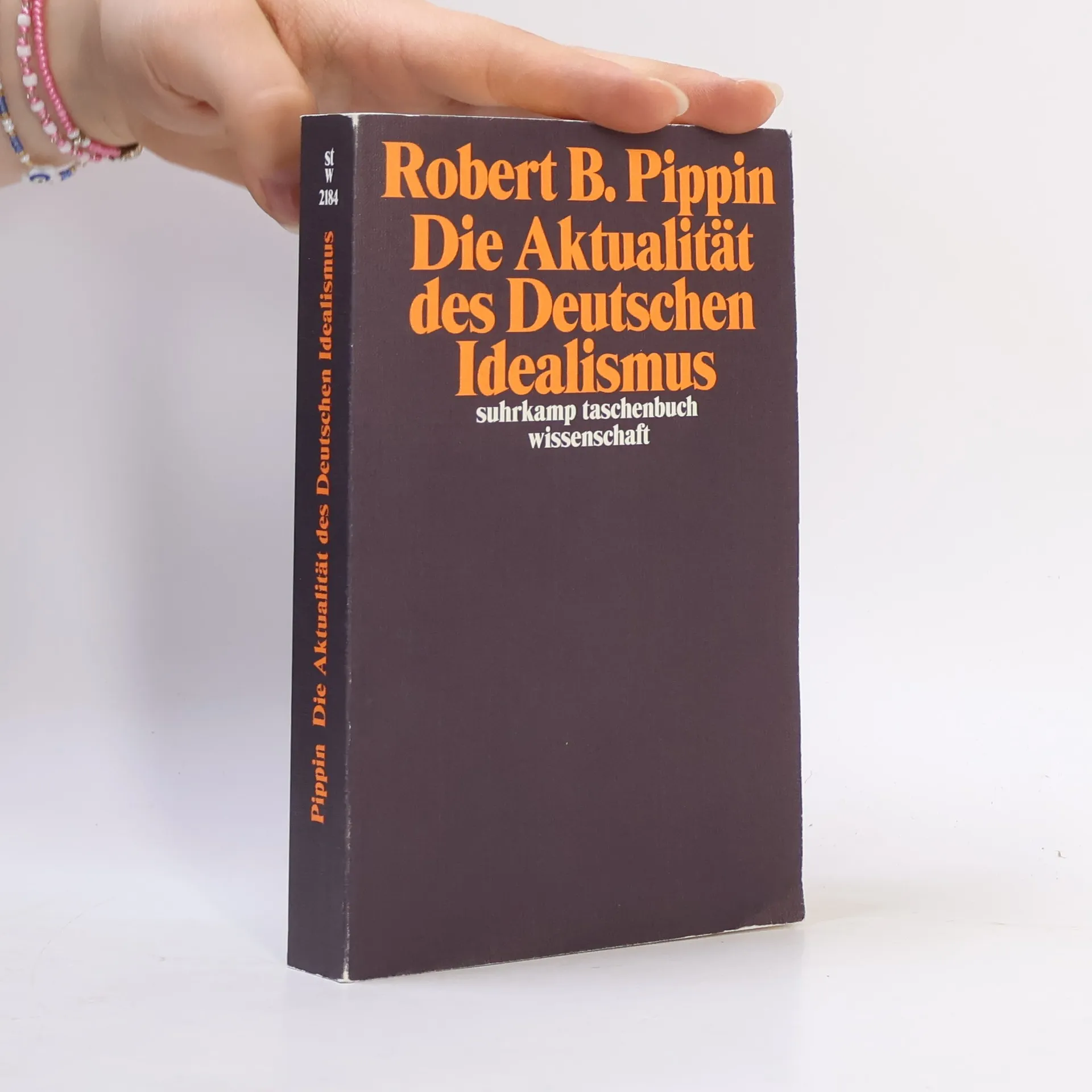
Die in diesem Band versammelten Aufsätze verbinden zwei Behauptungen. Die erste ist, dass die begrifflichen Neuerungen, die die großen Figuren der deutschen philosophischen Tradition, allen voran Kant und Hegel, entwickelt haben – Begriffe wie Selbstbewusstsein, Freiheit, Subjektivität, Logik, Geist und philosophische Methode –, nach wie vor von herausragendem philosophischem Interesse sind, also keineswegs als bloß historische Bestände betrachtet werden dürfen. Die zweite Behauptung lautet, dass eine Reihe klassischer Deutungen dieser Begriffe weder deren Radikalität noch deren philosophisches Potenzial in den Blick bekommen. Dieses Manko präzise zu benennen und zu beheben – und dabei die Aktualität des Deutschen Idealismus zu belegen – ist das Ziel dieses Bandes.
Interanimations
- 272pages
- 10 heures de lecture
Rigorism and the new Kant -- Robert Brandom's Hegel -- John McDowell's Germans -- Slavoj Zizek's Hegel -- Axel Honneth's Hegelianism -- Alexander Nehamas's Nietzsche -- Bernard Williams on Nietzsche on the Greeks -- Heidegger on Nietzsche on nihilism -- Leo Strauss's Nietzsche -- The expressivist Nietzsche -- Alasdair Macintyre's modernity.
Henry James and Modern Moral Life
- 206pages
- 8 heures de lecture
The book explores how Henry James's fiction presents a nuanced theory of moral understanding, delving into the complexities of human relationships and ethical dilemmas. It examines his characters' psychological depth and the moral choices they face, highlighting how these elements reflect broader philosophical questions. Through detailed analysis, the author illustrates James's unique perspective on morality, emphasizing the interplay between individual conscience and societal norms in his storytelling.
Fatalism in American Film Noir. Some Cinematic Philosophy
- 135pages
- 5 heures de lecture
This book reveals the ways in which American film noir explore the declining credibility of individuals as causal centers of agency, and how we live with the acknowledgment of such limitations.
Hegel on self-consciousness
- 103pages
- 4 heures de lecture
In the most influential chapter of his most important philosophical work, the Phenomenology of Spirit, Hegel makes the central and disarming assertions that "self-consciousness is desire itself" and that it attains its "satisfaction" only in another self-consciousness. Hegel on Self-Consciousness presents a groundbreaking new interpretation of these revolutionary claims, tracing their roots to Kant's philosophy and demonstrating their continued relevance for contemporary thought. As Robert Pippin shows, Hegel argues that we must understand Kant's account of the self-conscious nature of consciousness as a claim in practical philosophy, and that therefore we need radically different views of human sentience, the conditions of our knowledge of the world, and the social nature of subjectivity and normativity. Pippin explains why this chapter of Hegel's Phenomenology should be seen as the basis of much later continental philosophy and the Marxist, neo-Marxist, and critical-theory traditions. He also contrasts his own interpretation of Hegel's assertions with influential interpretations of the chapter put forward by philosophers John McDowell and Robert Brandom.
The Persistence of Subjectivity
- 380pages
- 14 heures de lecture
This book discusses approaches to the self-understanding and legitimation of the modern, 'bourgeois' life.
Die Verwirklichung der Freiheit
Der Idealismus als Diskurs der Moderne
Das Schlüsselproblem der modernen deutschen Philosophie betrifft die zentrale Verheißung der europäischen Moderne selbst: die Möglichkeit eines freien, ja sogar autonomen Lebens. Pippin problematisiert verschiedene gängige Charakterisierungen dieser Denktradition. Dabei präsentiert er eine originelle Interpretation der anspruchsvollsten Begründungen dieser Verheißung im Werke Kants und Hegels und verteidigt zugleich deren Freiheitsbegriff in einem Vergleich mit konkurrierenden Vorstellungen, insbesondere denen von Nietzsche, Heidegger, Leo Strauss, Blumenberg und Habermas.
Hegel on ethics and politics
- 358pages
- 13 heures de lecture
Brings together in translation the finest post-war German language scholarship on Hegel's social and political philosophy.
In seinem Werk zeigt Robert Pippin, dass Henry James in seinen Romanen und Erzählungen eine Neubegründung der Moral entworfen hat. James nimmt die Moderne als komplexe historische Situation ernst und erkennt deren Ambiguitäten, ohne in Skeptizismus oder Ästhetizismus zu verfallen. Pippin präsentiert neue Interpretationen aller großen Werke von James und belegt, dass der Erzähler einen eigenständigen und philosophisch fruchtbaren Beitrag zum Verständnis der modernen Moral geleistet hat. Das Buch richtet sich nicht nur an Philosophen und Literaturwissenschaftler, sondern auch an interessierte Leser von Henry James, da Pippin seine Argumente klar und ohne spezielles Vokabular darlegt. Richard Rorty von der Stanford University hebt hervor, dass Pippin der Leser ist, den James sich gewünscht hätte. Alice Crary von der New School University lobt die präzise Darstellung des moralischen Fundaments in James’ Romanen. Collin Meissner von der University of Notre Dame betont Pippins umfassende Argumentation zu den moralischen Konsequenzen des Modernismus und deren Reflexion in den Erfahrungen von James’ Figuren. David Bromwich von der Yale University würdigt Pippins sorgfältige Beobachtungen und seinen Blick auf die Details sowie die größeren Zusammenhänge der Texte.
The book challenges conventional views on modern philosophy by emphasizing concepts of agency, freedom, and ethical life rooted in the German idealist tradition, particularly Hegel's writings. Robert Pippin critically examines Hegel's perspectives and then broadens the discussion to include interpretations from Habermas, Strauss, Blumenberg, Nietzsche, and Heidegger, offering a comprehensive analysis of modernity through these philosophical lenses.
In this text the author offers an interpretation of Hegel's idealism which focuses on Hegel's appropriation and development of Kant's theoretical project. Hegel is presented neither as a pre-critical metaphysician nor as a social theorist, but as a critical philosopher.