

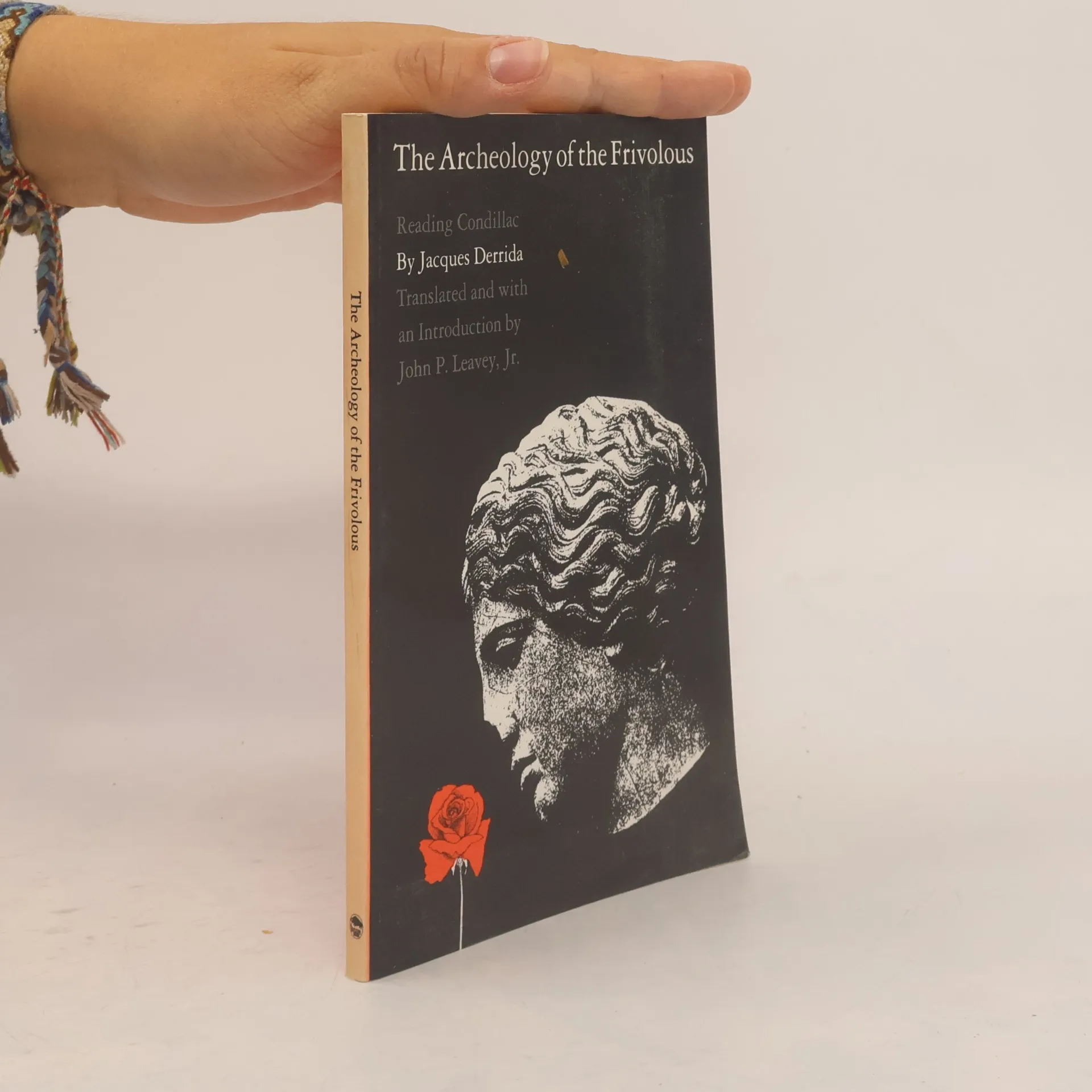
The Archeology of the Frivolous
Reading Condillac
En savoir plus sur le livre
In 1746 the French philosophe Condillac published his Essay on the Origin of Human Knowledge , one of many attempts during the century to determine how we organize and validate ideas as knowledge. In investigating language, especially written language, he found not only the seriousness he sought but also a great deal of frivolity whose relation to the sober business of philosophy had to be addressed somehow. If the mind truly reflects the world, and language reflects the mind, why is there so much error and nonsense? Whence the distortions? How can they be remedied?In The Archeology of the Frivolous , Jacques Derrida recoups Condillac's enterprise, showing how it anticipated--consciously or not--many of the issues that have since stymied epistemology and linguistic philosophy. If anyone doubts that deconstruction can be a powerful analytic method, try this.

Achat du livre
The Archeology of the Frivolous, Jacques Derrida, John P. Leavey, Jr.
- Langue

- Année de publication
- 1987
- Reliure
- (souple)
Modes de paiement
Personne n'a encore évalué .
- Titre
- The Archeology of the Frivolous
- Sous-titre
- Reading Condillac
- Langue
- Anglais
- Auteurs
- Jacques Derrida, John P. Leavey, Jr.
- Éditeur
- University of Nebraska Press
- Publié
- 1987
- Format
- souple
- Pages
- 143
- ISBN10
- 0803265719
- ISBN13
- 9780803265714
- Séries
- Catégories
- Description
- In 1746 the French philosophe Condillac published his Essay on the Origin of Human Knowledge , one of many attempts during the century to determine how we organize and validate ideas as knowledge. In investigating language, especially written language, he found not only the seriousness he sought but also a great deal of frivolity whose relation to the sober business of philosophy had to be addressed somehow. If the mind truly reflects the world, and language reflects the mind, why is there so much error and nonsense? Whence the distortions? How can they be remedied?In The Archeology of the Frivolous , Jacques Derrida recoups Condillac's enterprise, showing how it anticipated--consciously or not--many of the issues that have since stymied epistemology and linguistic philosophy. If anyone doubts that deconstruction can be a powerful analytic method, try this.