
Bookbot

Max Born

    11 décembre 1882 – 5 janvier 1970

    Max Born était un physicien et mathématicien germano-britannique qui a joué un rôle déterminant dans le développement de la mécanique quantique. Il a également apporté des contributions à la physique de l'état solide et à l'optique et a supervisé le travail d'un certain nombre de physiciens notables dans les années 1920 et 1930. Born a remporté le prix Nobel de physique en 1954 pour ses contributions à la mécanique quantique.

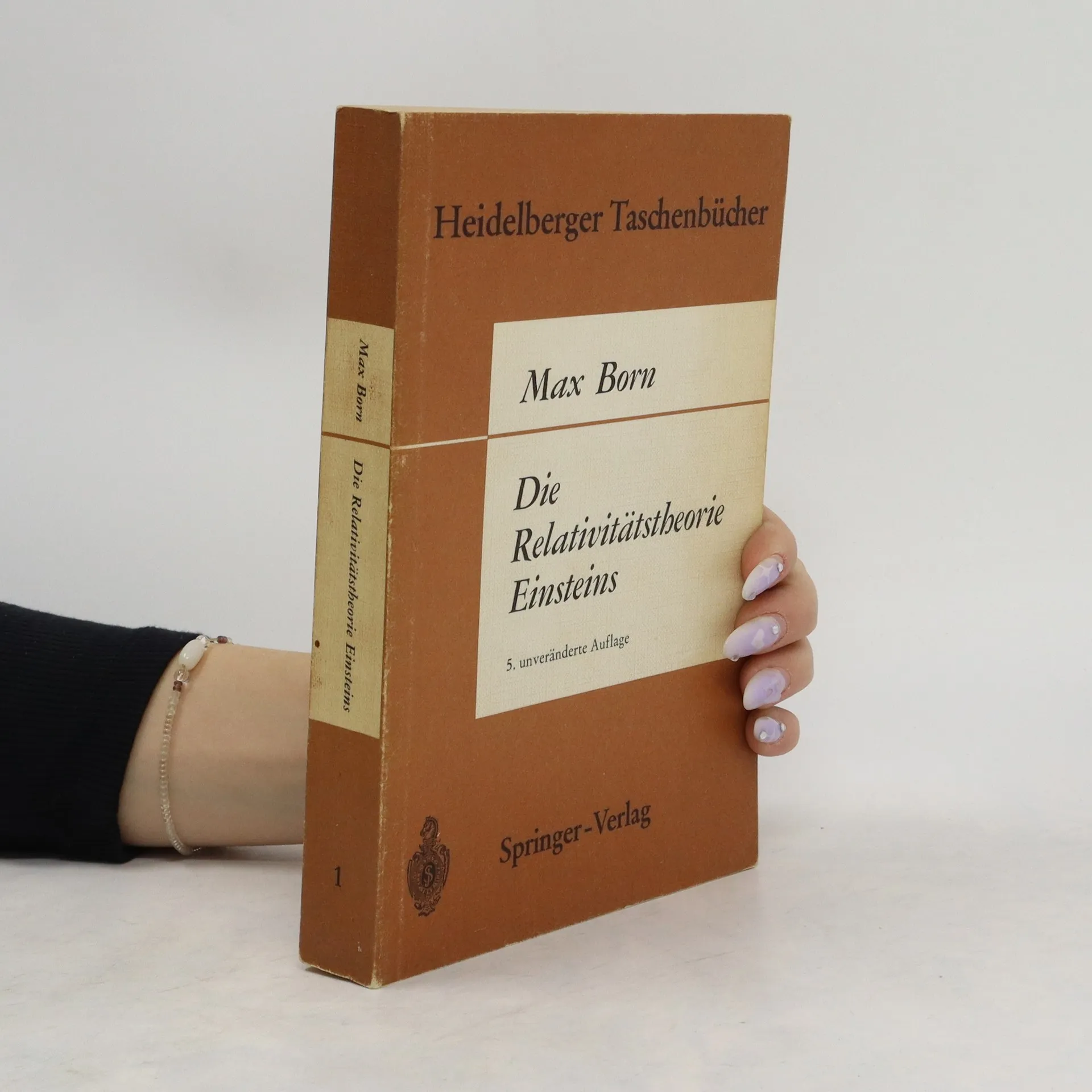
    Эйнштейновская теория относительности
    Atomic Physics
    On Fundamental Physics and Scientific Knowledge
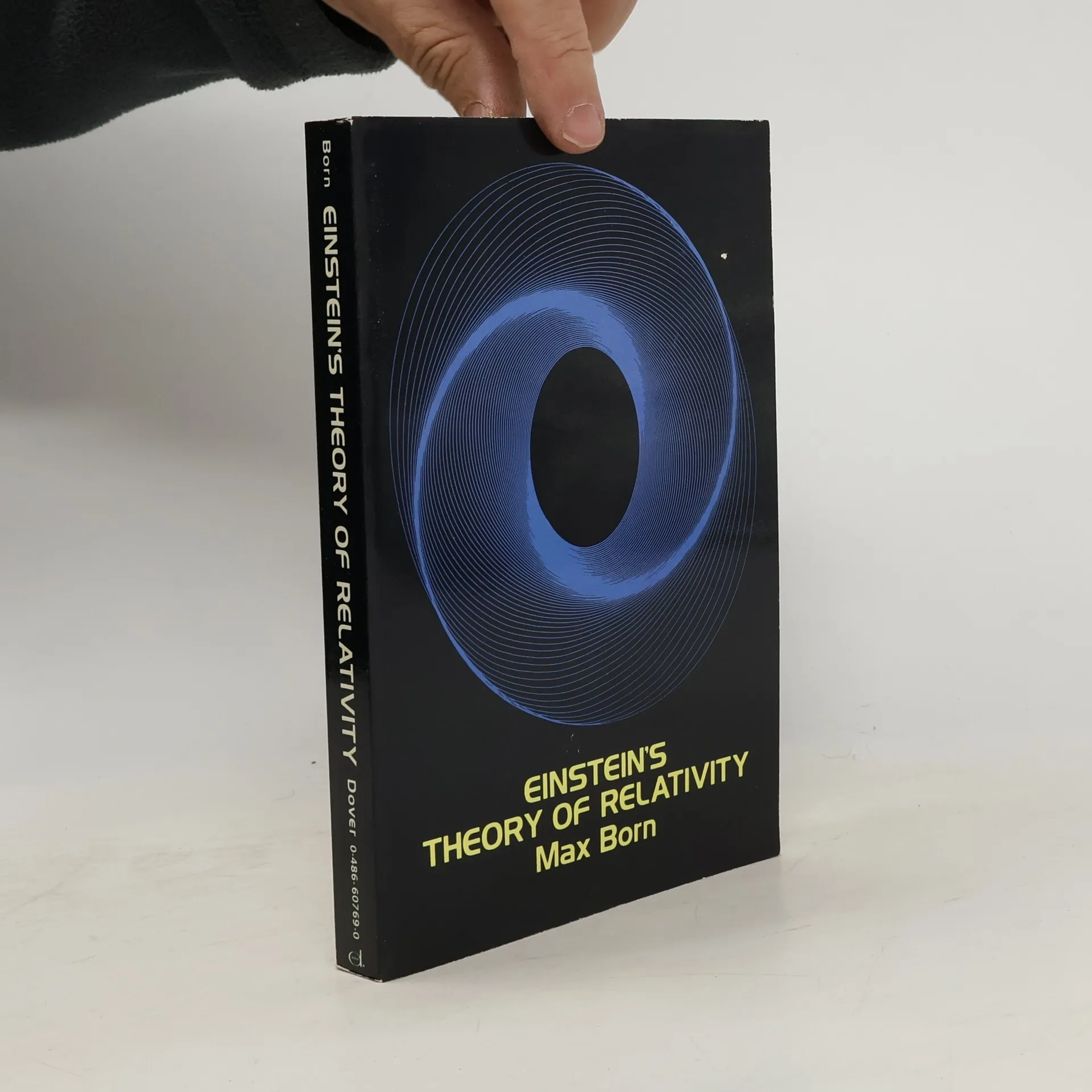
    Einstein's Theory of Relativity
    Principles of Optics
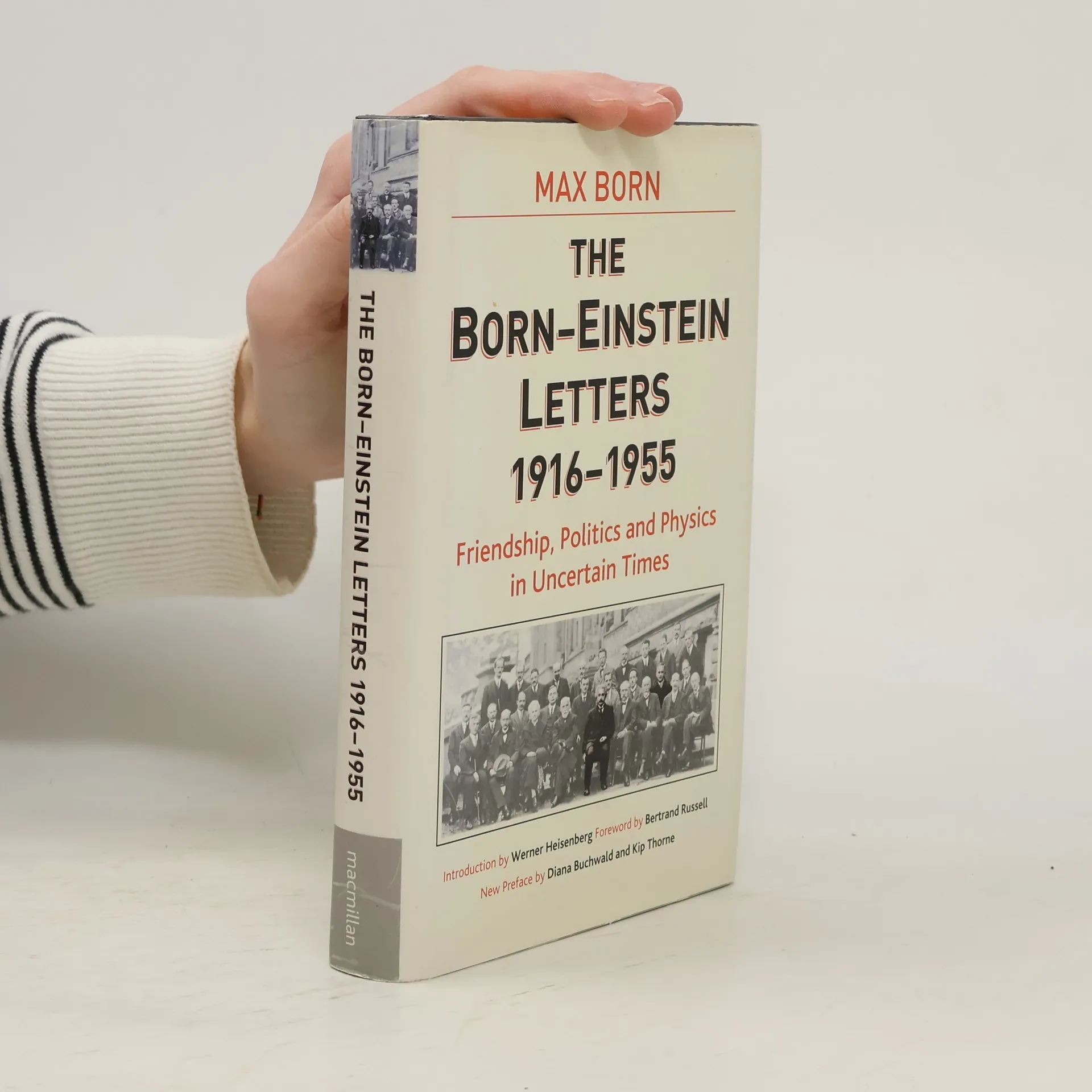
    The Born-Einstein Letters 1916-55
    • The Born-Einstein Letters 1916-55

      Friendship, Politics and Physics in Uncertain Times

      • 235pages
      • 9 heures de lecture

      Albert Einstein and Max Born were great friends. Their letters span 40 years and two world wars. In them they argue about quantum theory, agree about Beethoven's heavenly violin and piano duets (that they played together when they met) and chat about their families. Equally important, the men commiserate over the tragic plight of European Jewry and discuss what part they should play in the tumultuous politics of the time. Fascinating historically, The Born-Einstein Letters is also highly topical: scientists continue to struggle with quantum physics, their role in wartime and the public's misunderstanding. First published by Macmillan in 1971, this book is re-issued, with a substantial new preface by leading US physicists Kip Thorne and Diana Buchwald, as part of 2005's Relativity Centenary celebrations.


      The Born-Einstein Letters 1916-55
      4,1
    • Principles of Optics is a seminal work in the field of optics, now presented in its first thoroughly revised and expanded edition. This edition introduces significant new material, including a section on CAT scans, which have transformed medical diagnostics. A new chapter on scattering from inhomogeneous media offers an in-depth exploration of scattering theory for both scalar and electromagnetic waves, featuring the Born and Rytov series. It also discusses diffraction tomography, a refinement of CAT scans, highlighting Emil Wolf's foundational contributions from 1969. The chapter further examines scattering from periodic potentials and its relevance to crystal structure determination through X-ray diffraction, covering key concepts like von Laue equations, Bragg's law, and the Ewald sphere, which have gained importance in optics, particularly in deep holography. Additional topics include interference with broad-band light, revealing recent discoveries related to spectral line shifts due to source coherence, and the growing popularity of Rayleigh-Sommerfield diffraction theory. New appendices, including one on energy conservation in scalar wavefields, enhance the text. This edition remains an essential resource for advanced undergraduates, graduate students, and researchers in various optics fields.

      Principles of Optics
      4,1
    • A Nobel Prize-winning physicist explains the historical background and scientific principles of Einstein's famous theory

      Einstein's Theory of Relativity
      4,1
    • This collection contains a new publication of the Heisenberg, Born, Schroedinger and Auger, On Modern Physics and the Nobel lectures of Werner Heisenberg, Erwin Schroedinger and Max Born.In this collection three Nobel laureates and a renowned authority on space exploration discuss a wide range of issues - from lessons that can be learned from the ancient Greek philosophers, to the advancements in fundamental physics in the twentieth century, to the dark implications of scientific discoveries, to the methods and limits of scientific knowledge - in a language that is understandable by a wide audience.

      On Fundamental Physics and Scientific Knowledge
    • Atomic Physics

      • 495pages
      • 18 heures de lecture

      First published in English in 1935, this classic treatment is well known to students and teachers of physics around the world. Since its original publication, Professor Born (Nobel laureate, 1954) continually updated the book to incorporate new developments in all branches of physics, particularly in the field of elementary particles. For this eighth edition he also wrote a new chapter on the quantum theory of solids.Contents include:Kinetic theory of gasesElementary particlesSpin of the electron and Paul's principleThe nuclear atomWave-corpusclesAtomic structure and spectral linesQuantum statisticsMolecular structureQuantum theory of solidsNuclear physicsOver 40 helpful appendixes, dealing with the mean square deviation, theory of relativity, electron theory, the Compton effect, Hamiltonian theory and action variables, atomic form factor, meson theory, van der Waals forces, and other topics supplement the main text. A bibliography and numerous figures and graphs further enhance the usefulness of Atomic Physics, which retains its value as a broad treatment of basic physics from the special perspective of a towering figure in the field.

      Atomic Physics
    • Optik

      Ein Lehrbuch der elektromagnetischen Lichttheorie

      • 591pages
      • 21 heures de lecture

      Dieses Buch unterscheidet sich von alteren Darstellungen der Optik durch die Grenzziehung gegen andere Gebiete der Physik. Die liberkommene Einteilung (Mechanik, Elektrizitat und Magnetismus, Optik, Thermodynamik, erganzt durch kinetische Theorie der Materie und Atomphysik) ist wohl vorlaufig flir den Unterricht noch unentbehrlich, so wenig sie auch der Einheit des Lehr gebaudes Rechnung tragt. Die Optik ist seit langem als elektromagnetische Lichttheorie ein Sonderkapitel der allgemeinen Lehre yom elektromagnetischen Felde. Man kann sich dabei natlirlich nicht auf das sichtbare Licht beschranken, sondern muB den Frequenzbereich nach oben und unten erweitern. Die HERTZ schen Wellen pflegt man aber nicht hinzuzunehmen; nach kurzen Wellen zu scheint es geboten, die Rontgen-und y-Strahlen auszuschlieBen oder wenigstens nur andeutungsweise zu behandeln. Auch hier wird diesem Brauche gefolgt. Die Optik bewegter Korper durfte frliher in einem Lehrbuche der Lichttheorie nicht fehlen. lch halte das nicht fUr zeitgemaB; diese Dinge gehoren zur Rela tivitatstheorie, die sich zu einem besonderen Kapitel der Physik entwickelt hat.

      Optik