



Paramètres
- 168pages
- 6 heures de lecture
En savoir plus sur le livre
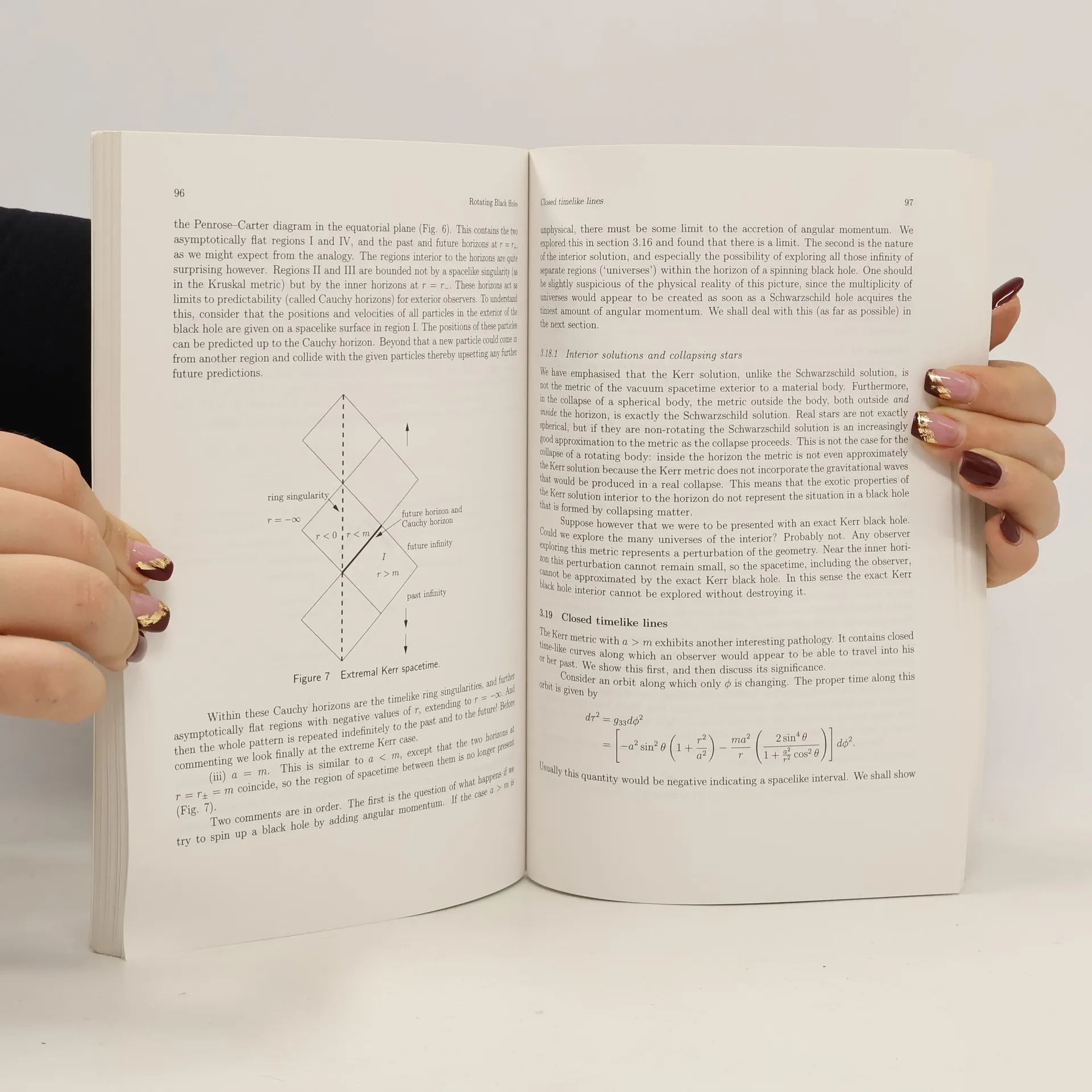
This introduction to the fascinating subject of black holes fills a significant gap in the literature which exists between popular, non-mathematical expositions and advanced textbooks at the research level. It is designed for advanced undergraduates and first year postgraduates as a useful stepping-stone to the advanced literature. The book provides an accessible introduction to the exact solutions of Einstein’s vacuum field equations describing spherical and axisymmetric (rotating) black holes. The geometry and physical properties of these spacetimes are explored through the motion of particles and light. The use of different coordinate systems, maximal extensions and Penrose diagrams is explained. The association of the surface area of a black hole with its entropy is discussed and it is shown that with the introduction of quantum mechanics black holes cease to be black and can radiate. This result allows black holes to satisfy the laws of thermodynamics and thus be consistent with the rest of physics.
Achat du livre
Black Holes, Derek J. Raine, Edwin George Thomas
- Langue

- Année de publication
- 2005
- Reliure
- (souple)
Modes de paiement
Il manque plus que ton avis ici.
- Titre
- Black Holes
- Sous-titre
- An Introduction
- Langue
- Anglais
- Auteurs
- Derek J. Raine, Edwin George Thomas
- Éditeur
- Imperial College Press
- Publié
- 2005
- Format
- souple
- Pages
- 168
- ISBN10
- 1860945880
- ISBN13
- 9781860945885
- Séries
- Mots clés
- Manuels, Sciences naturelles, Manuels universitaires, Science, Manuels de physique, Physique quantique, Trous Noirs
- Évaluation
- 3,8 sur 5
- Description
- This introduction to the fascinating subject of black holes fills a significant gap in the literature which exists between popular, non-mathematical expositions and advanced textbooks at the research level. It is designed for advanced undergraduates and first year postgraduates as a useful stepping-stone to the advanced literature. The book provides an accessible introduction to the exact solutions of Einstein’s vacuum field equations describing spherical and axisymmetric (rotating) black holes. The geometry and physical properties of these spacetimes are explored through the motion of particles and light. The use of different coordinate systems, maximal extensions and Penrose diagrams is explained. The association of the surface area of a black hole with its entropy is discussed and it is shown that with the introduction of quantum mechanics black holes cease to be black and can radiate. This result allows black holes to satisfy the laws of thermodynamics and thus be consistent with the rest of physics.